
Álvaro Peñas a writer for europeanconservative.com. He is the editor of deliberatio.eu and a contributor to Disidentia, El American, and other European media. He is an international analyst, specialising in Eastern Europe, for the television channel 7NN and is an author at SND Editores.
What is your assessment of the scale and nature of the July–August 2026 migrant surge into Ceuta? How does it compare with previous crises in the Spanish enclaves?
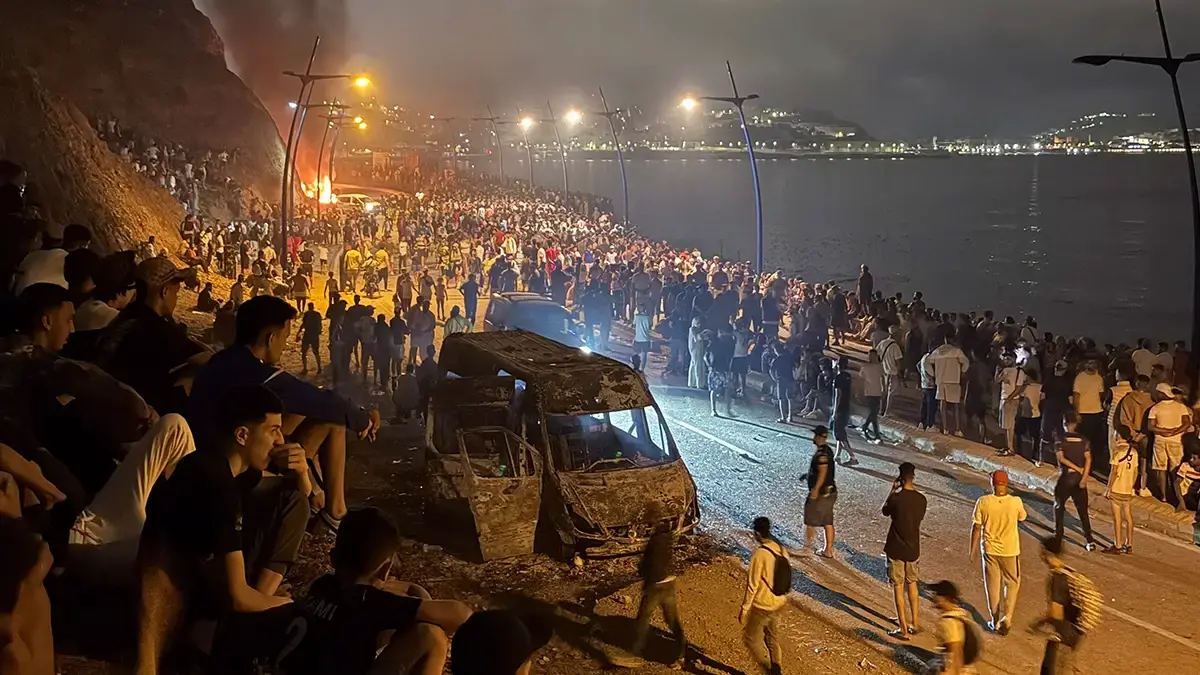
Nothing like this has ever happened before, and even Pedro Sánchez himself described it in the early hours as an attack on Spain’s sovereignty and territorial integrity. The most serious previous incident occurred in May 2021. On that occasion, around 15,000 Moroccans, many of them minors, stormed the border at Ceuta to watch a football match in which Cristiano Ronaldo was due to play. The match was nothing more than a fabrication by the Moroccan authorities, but the border breach forced the deployment of military units. Now we are talking about between 60,000 and 80,000 people, the figures vary depending on the source, breaching the border and entering, by sea and by land, a city with a population of 83,000.
To a lesser extent, the events in Ceuta are reminiscent of the so-called ‘Green March’ in early November 1975, when the Kingdom of Morocco seized Western Sahara – then a Spanish possession – by sending 350,000 Moroccan civilians accompanied by some 20,000 military personnel. At that time, the Spanish government was unable to respond to the Moroccan aggression because the regime was crumbling – General Franco was to die on 20 November – and the military forces withdrew in the face of the throng of civilians who, waving Moroccan flags and portraits of King Hassan II, occupied the Spanish territory.
Many observers describe the mass crossing of 70,000+ people in a matter of hours as a form of hybrid warfare or deliberate pressure by Morocco. Do you share this view, and what evidence supports it?
Absolutely. This invasion was not a chance occurrence, but a punitive operation by the Moroccan government against Spain. In May 2021, the hoax about the football match that triggered the mass influx into Ceuta was the result of the Spanish government allowing – allegedly on humanitarian grounds – the leader of the Polisario Front, Brahim Ghali, to be flown in April from Algeria to a military base in Zaragoza to receive treatment for a serious illness. The Polisario Front is at war with Morocco to secure the independence of Western Sahara, so his presence in Spain triggered a diplomatic crisis with Morocco, which the government in Rabat resolved by storming Ceuta. Now, the trigger has been the signing of an agreement with Algeria to increase gas imports. On 17 July, Pedro Sánchez met with leading Algerian officials to usher in ‘a new era’ in bilateral relations – relations that had deteriorated in 2022 following the Spanish government’s decision to change its stance on the Sahara and support Morocco’s position. It is clear that this new era in relations with Algeria – a country hostile to Morocco – is not to the liking of King Mohammed VI, and the consequence has been this latest invasion.
Reports from the police and the CNI (National Intelligence Centre) warned that an assault on Ceuta could take place on 30 July, to coincide with Throne Day, marking the 27th anniversary of the coronation of Mohammed VI. They warned that two groups on social media, with a combined total of 180,000 followers, were calling for an incursion into Ceuta by land and sea. Meanwhile, the National Police’s National Centre for Immigration and Borders (Cenif) produced a document highlighting the collaboration of Moroccan gendarmes in guiding the migrants who carried out the assault on the city. Other reports highlight Moroccan cooperation in border control right up until the day the invasion took place. Morocco opens and closes the tap on illegal immigration as it sees fit.
How would you evaluate the Spanish government’s response under Pedro Sánchez — both in the immediate days after the surge and in the weeks that followed, as thousands of migrants remained in the city?
Pedro Sánchez’s government denied having received any warning of what was about to happen, blaming the CNI for failing to foresee the events. The reality is that there were reports from the CNI, the Civil Guard, the National Police, and even the army, and the government decided to ignore them. And the response to the request for more personnel was to send 12 Civil Guard officers and police officers, three of whom were trainees. I mentioned earlier that Pedro Sánchez initially spoke of an “attack” but has since abandoned that line. When the transport minister was asked a few days ago who was behind the attack, his reply was: “poverty”.
The Spanish Government seems far more concerned with dismissing Morocco’s role in this invasion than with resolving it. And the only reason that can explain this is the so-called ‘Pegasus affair’, which came to light in May 2022 and revealed that Pedro Sánchez’s mobile phone had been bugged by the Moroccan secret services in 2021. What might Morocco have discovered about Sánchez? We do not know, but since then the Spanish Government has done nothing but cave in to Moroccan blackmail.
Ceuta has a population of roughly 84,000. What are the concrete social, security, and demographic consequences of having several thousand (local estimates say up to 10,000) additional young men concentrated in such a small territory for weeks?
According to the Ceuta city council, there are currently 13,000 illegal immigrants in the city. Since the start of the invasion, the city has been in a state of collapse, the economy is on the brink, and direct losses exceed 33 million euros. People are afraid and many are trying to avoid going out onto the streets; around 30 per cent of pupils did not attend school at the start of the academic year. There have been 30 sexual assaults, including rapes, mainly against migrant women, although there have been some cases involving Spanish victims, and 40 per cent of the victims are minors. The illegal camps are raising health concerns due to unsanitary conditions and the proximity of the shacks to the drinking water desalination plant. It is an unsustainable situation, in which the inhabitants of Ceuta have lost their freedom.
Local residents have staged protests, and there have been reports of rising crime, sexual assaults, and vigilante reactions. How serious is the breakdown of public order, and is the Spanish state still capable of guaranteeing the safety of its citizens in Ceuta?
Residents of Ceuta have been protesting for weeks against this situation and the rise in crime. Every night, brawls break out amongst the migrants, and this weekend there were two serious stabbings. Vehicles and rubbish bins have also been set alight. The areas where migrants are camping are seeing an ever-increasing number of shacks, and there are beaches – such as Trampolín – where, according to police unions, there is now even a drug market. For the time being, it appears that the government’s intention is to move the migrants to temporary camps in order to clear the beaches, But this is not a solution; it is simply shifting the problem from one place to another. Police reinforcements have been sent in and army patrols have been deployed, initially unarmed, and now, after they have suffered several ambushes, one of the soldiers is armed.
The presence of a large number of unaccompanied minors has been repeatedly highlighted by the government. How should Spain and the EU handle this category in a situation of mass irregular entry, and what risks does the current approach create?
Minors must be with their parents, and in the case of Morocco, this is not an impossible task. Both Spanish and European law prohibit the mass or collective return of minors, although they do allow for this on a case-by-case basis, provided that the child is returned to their family, a guardian, etc. This entails costs which, of course, should be borne by Morocco and not by Spain. The major problem that Ceuta is warning about is that our system is not prepared for the use of illegal immigration as a weapon, and that is what needs to change.
On the other hand, the presence of minors is the favourite argument used by the Government and left-wing parties to attack anyone who describes what happened in Ceuta as an invasion. They never stop talking about children and a humanitarian crisis, when the vast majority of those involved are young men. This sort of propaganda has worked for a long time, but when you see a city overrun, the truth becomes clear.
Morocco has long used migration as a lever against Spain (and by extension the EU). What should a serious Spanish or European policy toward Rabat look like after this episode?
What is needed is an immigration policy that does not constantly demonstrate weakness. What makes absolutely no sense is that Spain and the European Union continue to send millions of euros to Morocco in the form of all kinds of aid and invest in infrastructure development in that country. This aid, at the same time, is detrimental to our fishing and agricultural sectors. The situation is so absurd that Spain and Portugal are set to co-host the 2030 World Cup with Morocco; naturally, this proposal came from Pedro Sánchez. It’s as if Poland and Brussels were sending money to Belarus and paying for its roads whilst Lukashenko’s regime continues to send illegal migrants towards the European borders in Poland and the Baltic states. A hybrid war attack must be met, at the very least, with the closure of borders, the suspension of all aid and diplomatic pressure. Failure to do so makes us look weak – and also foolish.
Does the Ceuta crisis expose deeper failures in Spain’s border control, asylum system, and political will? What concrete measures would you propose to restore control?
Ceuta is certainly exposing all the failings of a system that is ill-equipped to deal with this sort of situation. The lack of resources is worrying, but it is something that can be resolved. However, the most serious issue is the lack of political will. In the case of the Spanish Government, its subservience to Morocco is extremely serious. Not only did the Government fail to act despite warnings that the assault was going to take place, but it is also doing everything possible to distance Morocco from what is happening, insisting that it is a friendly and reliable country. Therefore, the most urgent step to restore control is a change in political leadership and a government that is not at the service of a foreign country with territorial claims against Spain.
From a conservative perspective, what political and cultural lessons should European nations draw from Ceuta regarding mass migration, national sovereignty, and the sustainability of open-border approaches?
There is no national sovereignty without borders, just as there is no house without doors. It is more than obvious, but we live in a time when one has to fight just to say that the grass is green. Similarly, national sovereignty can be violated in various ways: with tanks and drones, as Russia is doing in Ukraine, or with waves of illegal immigrants, as has happened in Ceuta, Lampedusa or on the Polish border. That is why national sovereignty must be defended at the borders against all kinds of threats. Do-goodism and open borders are incompatible with national sovereignty and, in the current climate of hybrid warfare, are nothing short of suicidal.
Looking ahead, do you believe the Ceuta crisis will have lasting political consequences inside Spain — for Sánchez’s government, for the opposition, and for public attitudes toward immigration?
At the demonstration on 2 September, Ceuta Day, the crowd chanted: ‘Ceuta will be the grave of Sanchismo!’ And in a way, I think that’s how it’s going to be. I’ve spoken to left-wing voters, and the vast majority have been horrified by the images we’ve seen from Ceuta. The defenselessness of Ceuta’s inhabitants is plain for all Spaniards to see, and the feel-good rhetoric about human rights or references to the far right, fascism and xenophobia are having less and less effect on a population fed up with propaganda. More and more Spaniards are realizing that, if they want a future, they must oust Sánchez and his gang from government.